
The August numbers say two things at once: Logoclothz is building real search and AI-search visibility, and the next optimization job is turning more of that visibility into clicks and qualified buying activity.
The 30-day report shows growth across Google, Bing, site engagement, key events, and AI-referral traffic. The latest seven-day readout is more mixed: impressions rose while Google clicks and CTR softened, yet tracked revenue and AI Assistant sessions increased sharply. That is not a contradiction. It is the operating brief: preserve the reach, repair the click-through rate, and keep publishing answers buyers can use.
Read the reporting windows before reading the scoreboard
These are three different lenses, not one blended time series. Keeping the windows separate prevents an honest short-term dip from hiding longer-term momentum—or the monthly momentum from hiding work that needs attention now.
| Evidence set | Reporting window | What it answers |
|---|---|---|
| 30-day Google + Bing report | June 30–July 29, compared with the prior 30 days | Is organic search, engagement, and revenue compounding? |
| Weekly 7-on-7 report | August 8–14, compared with August 1–7 | What needs attention right now? |
| AI-search visibility snapshot | Supplied three-month snapshot | Is Logoclothz appearing more often in answer-engine environments? |
The 30-day story: reach, engagement, and AI referrals all moved forward
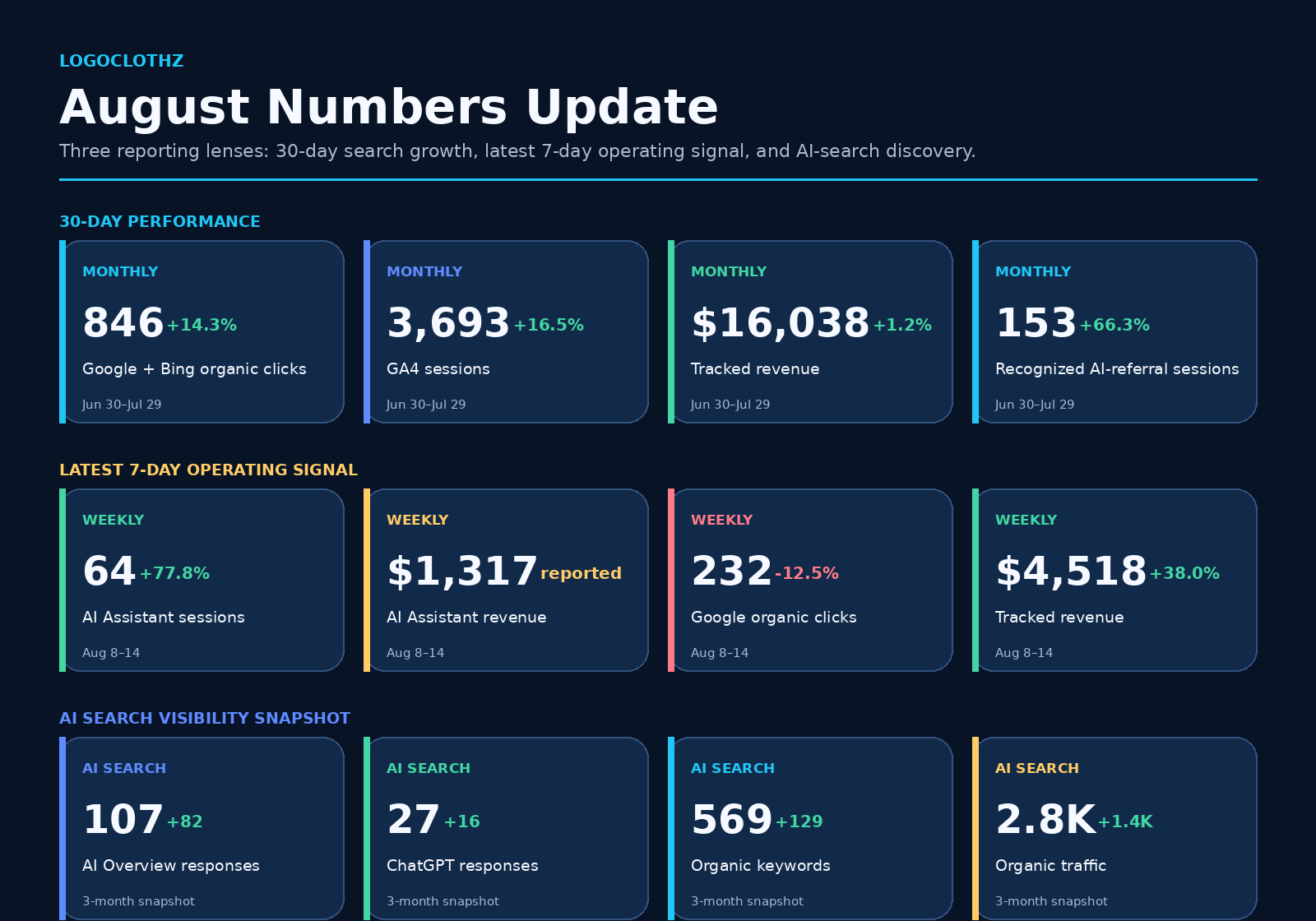
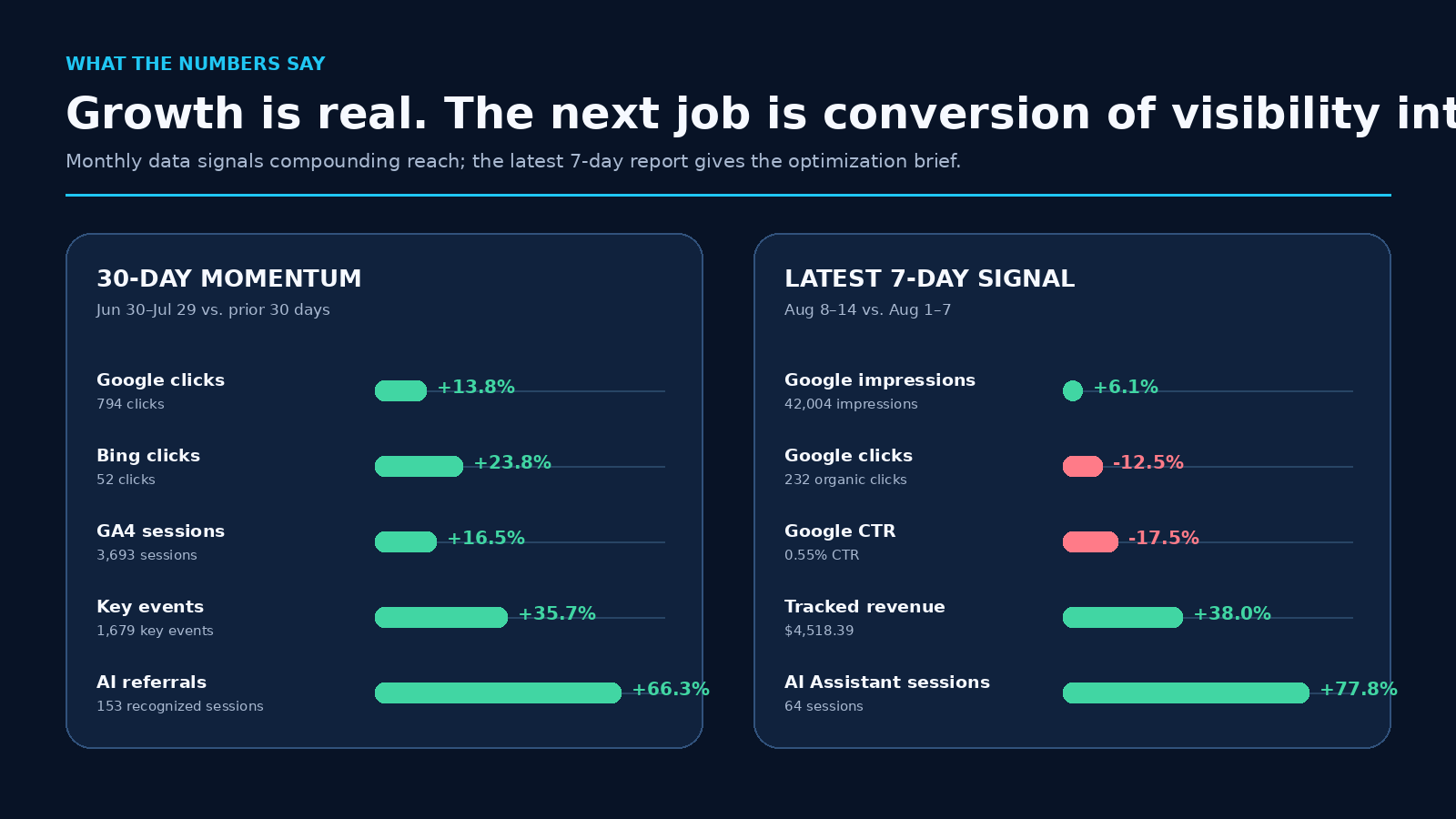
For the 30 days ending July 29, Google and Bing produced 846 combined organic clicks, up 14.3%. Google clicks rose to 794, Bing clicks rose to 52, GA4 sessions reached 3,693, and key events reached 1,679. Tracked revenue reached $16,038.35, a measured 1.2% increase over the prior 30-day period.
The AI-referral signal is particularly useful because it connects visibility to behavior, not just an answer-engine mention. Recognized AI sources generated 153 sessions, 182 key events, and $969.60 in tracked revenue during the same monthly reporting window. ChatGPT accounted for the largest share of the observed AI-referred sessions, with smaller contributions from Claude and Gemini.
| 30-day KPI | Current period | Change vs. prior 30 days |
|---|---|---|
| Google + Bing organic clicks | 846 | +14.3% |
| Google clicks | 794 | +13.8% |
| Bing clicks | 52 | +23.8% |
| GA4 sessions | 3,693 | +16.5% |
| GA4 key events | 1,679 | +35.7% |
| Tracked revenue | $16,038.35 | +1.2% |
| Recognized AI-referral sessions | 153 | +66.3% |
| AI-attributed tracked revenue | $969.60 | Reported current-period value |
The latest seven days: more visibility, less click-through, stronger revenue
The latest weekly report covers August 8–14. Google Search Console recorded 42,004 impressions, up 6.1%, but organic clicks were 232, down 12.5%, and CTR declined from 0.67% to 0.55%. Average position moved from 8.41 to 8.66.
That deserves attention, not spin. The high-impression pages and queries have more reach than the prior week, but their title, snippet, and intent match need to do more work. At the same time, tracked revenue reached $4,518.39, up 38.0%, and AI Assistant sessions rose 77.8% to 64, with $1,317.24 in reported AI Assistant revenue.
AI-search visibility is now a measurable part of the build
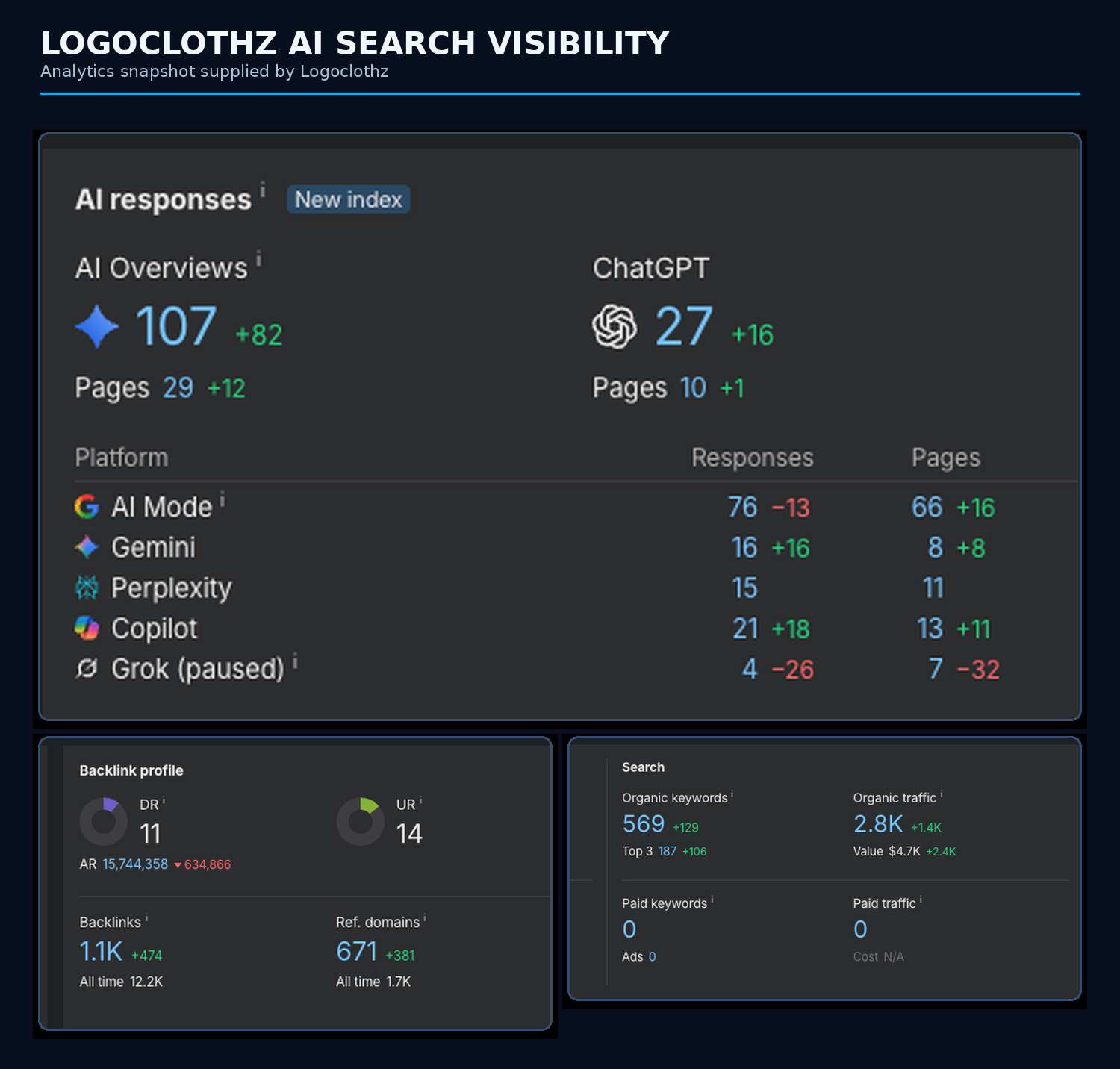
The supplied three-month AI-search snapshot reports 107 AI Overview responses, a displayed increase of 82, and 27 ChatGPT responses, a displayed increase of 16. It also reports 569 organic keywords with a displayed increase of 129, 187 Top 3 keywords with a displayed increase of 106, and 2.8K organic traffic with a displayed increase of 1.4K.
This is the outcome I want to measure—not because an AI mention is a vanity metric, but because the same source-grounded content system should help more buyers discover a clear answer, evaluate a product with confidence, and take the next step when the query has commercial intent.
What the workflow changed
The operating system behind these results is not “publish more AI content.” It is a tighter loop between verified business facts and buyer questions.
NotebookLM was used as the discovery layer for the Logoclothz work: organize trusted product information, existing pages, and anonymized customer language; surface recurring buyer questions; identify where the website did not answer those questions clearly; and turn the verified gaps into publishable briefs. The content itself still requires subject-matter review, accurate product claims, sound page structure, and a path that helps the buyer move forward.
That is the difference between a content factory and a content system. The first produces volume. The second improves the answer that matters on the page that matters.
For the earlier search implementation, read the Logoclothz SEO 12-Day Checkpoint. For the beginner version of the research process, see How to Use NotebookLM for AEO. The deeper operating model is documented in How I Built an AEO Intelligence Stack.
The next 30 days: turn exposed demand into more clicks and conversions
The data gives a clean priority list. First, improve title and meta-description relevance for high-impression, low-CTR commercial terms such as “custom tablecloth,” “custom table covers,” “custom tablecloth with logo,” and “custom table cloth.” Those are not traffic problems. They are relevance-and-click problems.
Second, keep restoring exact sizing and dimension language where buyers use it. The earlier checkpoint identified lost dimension-query coverage after question-style title rewrites. The fix remains additive: add direct dimension sections and short answer blocks to the relevant guides, retain the newer high-volume question phrasing, and measure the cohort rather than guessing.
Third, continue publishing concise, verifiable answer blocks for repeated buyer questions. AI-referral sessions and answer-engine visibility are now part of the measurement system, so the work can be evaluated as a funnel: visibility, qualified visits, key events, and revenue.
The August takeaway: Logoclothz has evidence of stronger organic reach, stronger engagement, meaningful AI-referral activity, and growing answer-engine visibility. The next edge is not more noise. It is clearer commercial snippets, better intent matching, and disciplined measurement of the pages already earning attention.
Source note and methodology
The monthly figures in this update come from the internal LogoClothz 30-Day Google + Bing AI Growth Intelligence Report, generated August 1, 2026, for June 30–July 29 compared with May 31–June 29. The weekly figures come from the internal LogoClothz 7-on-7 Growth Intelligence Report, generated August 17, 2026, for August 8–14 compared with August 1–7. AI-search response and backlink figures are transcribed from the supplied three-month analytics snapshot. Periods are intentionally reported separately, and the data should be interpreted as operational evidence rather than proof that any single tactic caused the result.
This is a public Build Log update on the work behind Logoclothz. The operating lesson is reusable: build from verified facts, let real buyer questions set the content agenda, and measure outcomes without pretending the system is magic.
Find me across the web

Stay curious, my AI friend. It's the secret sauce - think like you are seven. - Ryan