
Your AI Is Not an Asset If You Cannot Move It
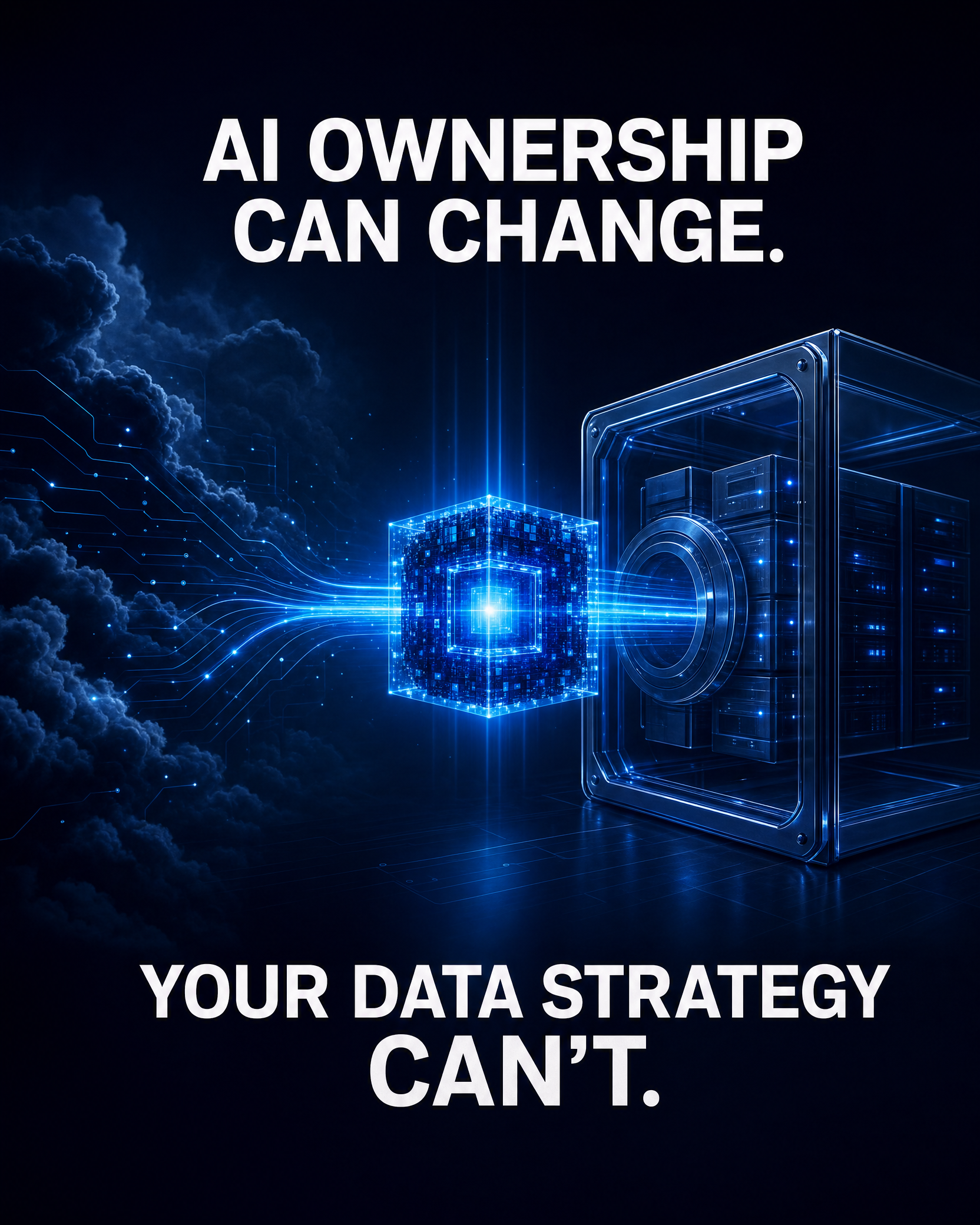
Free download: Get the AI Exit Readiness Action Sheet and score whether your infrastructure and data can survive an AI vendor exit, shutdown, or ownership change.
The Manus transition is a reminder that AI portability is now an operating requirement, not a technical nice-to-have.
Everybody loves the speed of AI until the platform they built around changes ownership, changes terms, changes where data lives, or becomes unavailable when they need it most.
That is not a reason to panic. It is a reason to build like an operator.
Manus has announced that it will return to independent operations following its separation from Meta. Its official user notice makes an important distinction: it is not a permanent shutdown and not a security incident. However, some affected users must back up certain data before a transition window, after which they can restore it. Unaffected users can continue using the service as usual.[1]
The news matters beyond Manus. It is a clean, real-world example of a problem most businesses have been ignoring: if your AI system is valuable but you cannot move the data, workflow logic, knowledge, and access that make it valuable, you do not fully control an asset. You are renting a dependency.
This is the same principle behind my Stop Renting Your Intelligence manifesto. Use the best tools available. Just do not confuse access to a tool with ownership of the intelligence, operating process, or business value you built inside it.
First, Get the Manus Story Straight
The internet is already doing what the internet does. “Manus is closing.” “All data is being deleted.” “There was a breach.”
That is not what the official notice says.
Manus says it is resuming independent operations. It says that certain users, not everyone, are affected by a data backup and restoration process related to its separation from Meta and regulatory requirements in specific jurisdictions. The affected data is data generated on or after December 29, 2025. The company says affected users can back up data before the August 23 to August 24 Singapore Time deletion window and restore it beginning August 25. It explicitly says this is not the result of a data breach or security incident.[1]
Reuters reported in April that Chinese regulators had ordered Meta to unwind its acquisition of Manus. That provides the broader ownership and regulatory context, but it does not change the practical lesson for operators: an external business event can quickly become an internal continuity problem if your work is trapped inside someone else’s environment.[2]
The point is not that AI vendors are unreliable. The point is that ownership, policy, regulation, and product decisions can change without asking your business for permission.
The New Risk Is Not Just Data Loss
When people hear “backup,” they think files. That is too narrow for AI.
Your AI capability may live in prompts, custom instructions, uploaded documents, agent configurations, connected tools, outputs, training examples, approval logic, account permissions, and the human judgment that tells the system when to stop. If one of those pieces disappears, a simple export of chat history will not rebuild the operation.
The real risk is operational amnesia. Your team remembers that the AI “does the thing,” but nobody can explain where the source material lives, what the decision rules are, who owns the credentials, what must be reviewed by a human, or how to recreate the workflow somewhere else.
NIST’s AI Risk Management Framework exists for exactly this kind of mature thinking. It is voluntary guidance designed to help organizations manage AI risks while supporting trustworthy, responsible use. It frames AI risk management as an ongoing discipline, not a one-time compliance checkbox.[3]
For a small business, that does not mean writing a 90-page policy nobody reads. It means being able to answer a few uncomfortable questions before a vendor event forces the issue.
| Question | What a healthy answer sounds like |
|---|---|
| Where is the original data? | “In our own drive, CRM, database, or repository. The AI platform uses a controlled copy or connection.” |
| Can we reproduce the workflow? | “Yes. The prompt, inputs, steps, approvals, and output format are documented outside the vendor.” |
| Who controls access? | “The business controls the master account, recovery method, billing relationship, and team permissions.” |
| What breaks if the platform changes? | “We know the dependencies, the temporary manual workaround, and the next platform we would test.” |
| Have we proved it? | “We exported a representative workflow and restored or recreated it in a test.” |
If those answers are vague, you have a portability gap.
Portability Is Not “Use Every Tool”
Let me kill another bad idea before it spreads.
Portability does not mean using five AI tools for every task. That creates tool sprawl, fractured data, and a team that spends more time comparing tabs than serving customers.
Portability means you choose a primary tool deliberately, then keep the business-critical parts of the operation outside that tool’s locked room.
A strong AI stack has a clear center of gravity. It might be one agent platform, one model provider, or one workflow system. That is fine. The important part is that the value your business creates can survive a change around that system.
Think of the AI platform as a high-performance vehicle. You should enjoy driving it. You should also keep the map, fuel, maintenance notes, and spare key somewhere other than the glove compartment.
The Five Layers of an AI Portability Plan
A practical portability plan protects five things.
1. Your source data
Keep the original documents, product details, customer records, research, images, spreadsheets, and approved copy in systems you control. The AI should work from a governed source, not become the only place where the source exists.
This is especially important for client work. If your only record of an approved strategy, article, proposal, or deliverable is inside an AI task history, you have made a temporary workspace your system of record. That is sloppy operations dressed up as innovation.
2. Your workflow instructions
Save the instruction set that produces a useful result. That includes the prompt, model settings when relevant, required inputs, desired output structure, guardrails, exception handling, and human approval point.
Do not save a random 2,000-word prompt with no context and call it a system. Save a clear operating document that another competent person can understand and run.
3. Your knowledge architecture
Your knowledge base should be organized independently of one AI interface. Keep source documents, a plain-language index, ownership details, access rules, and version history in a durable location.
The model is the reader. Your knowledge system is the library. Never let the reader become the only copy of the books.
4. Your identity and access controls
A portability plan fails if the person who created the tool account leaves, loses their email access, or owns the only multi-factor authentication device.
Use business-controlled email addresses, documented recovery paths, least-privilege access, and regular permission reviews. This is not glamorous work. Neither is being locked out of your own company on a Monday morning.
5. Your continuity test
This is the part most people skip because it requires actual effort.
Do a small recovery drill. Export one representative workflow. Put its source files, instructions, and sample outputs in a controlled location. Then ask someone on the team to recreate the result without relying on the original platform’s task history.
If it cannot be recreated, you have not built a system. You have built a dependency with good branding.
Run a 30-Minute AI Portability Drill This Week
You do not need a committee, a consultant, or a binder with fake seriousness in it. Pick one important workflow and do this:
| Minute | Action | Output |
|---|---|---|
| 0-5 | Choose one AI workflow that affects revenue, clients, or operations. | A named use case with a business owner. |
| 5-10 | Identify the original inputs, outputs, prompt or instructions, connected tools, and account owner. | A one-page workflow inventory. |
| 10-15 | Export the work and place the source material in a business-controlled location. | A recovery folder with clear ownership. |
| 15-25 | Document how the workflow would run manually or on a second platform. | A fallback procedure. |
| 25-30 | Assign a date to retest it and list the gaps you found. | A short continuity backlog. |
You will find gaps. Good. That is the whole point.
AI adoption has moved beyond “Can this write an email?” The serious question is now, “Can this capability survive a change in vendor, ownership, regulation, or team?”
The companies that win with AI will not be the ones that chase every shiny tool. They will be the ones that turn useful tools into durable, documented, human-accountable operating systems.
The Strong Truth
A platform changing ownership should not be able to erase your operational memory.
The Manus transition is not a reason to abandon the tools you like. It is a reason to use them with your eyes open. Back up what matters. Document what works. Keep the source material under your control. Test whether you can move.
Build fast. Stay portable. Keep a human in the loop where it matters.
That is how you benefit from AI without handing over the keys to your business.
Frequently Asked Questions
Is Manus shutting down?
No. Manus says it is returning to independent operations. Its notice says only certain affected users need to use a backup and restoration process, while unaffected users can continue using the service normally.[1]
Is the Manus transition a data breach?
No. Manus states that the transition is not the result of a security incident or data breach.[1]
Does AI portability mean I need multiple AI vendors?
No. A primary vendor can be the right choice. Portability means keeping the important inputs, workflow instructions, knowledge, access controls, and fallback process independent enough that you can recover or move if required.
What should I back up from an AI platform?
Start with source data, approved outputs, reusable workflow instructions, knowledge-base documents, key configurations, account ownership details, and a plain-language runbook for your highest-value workflows.
References
[1] Manus, “A Note to Our Users,” August 11, 2026
[2] Reuters, “China orders Meta to unwind $2 billion purchase of AI startup Manus,” April 27, 2026
[3] National Institute of Standards and Technology, AI Risk Management Framework
Stay curious, my AI friend. Think like you are seven.
Ryan
Find me across the web


Stay curious, my AI friend. It's the secret sauce - think like you are seven. - Ryan